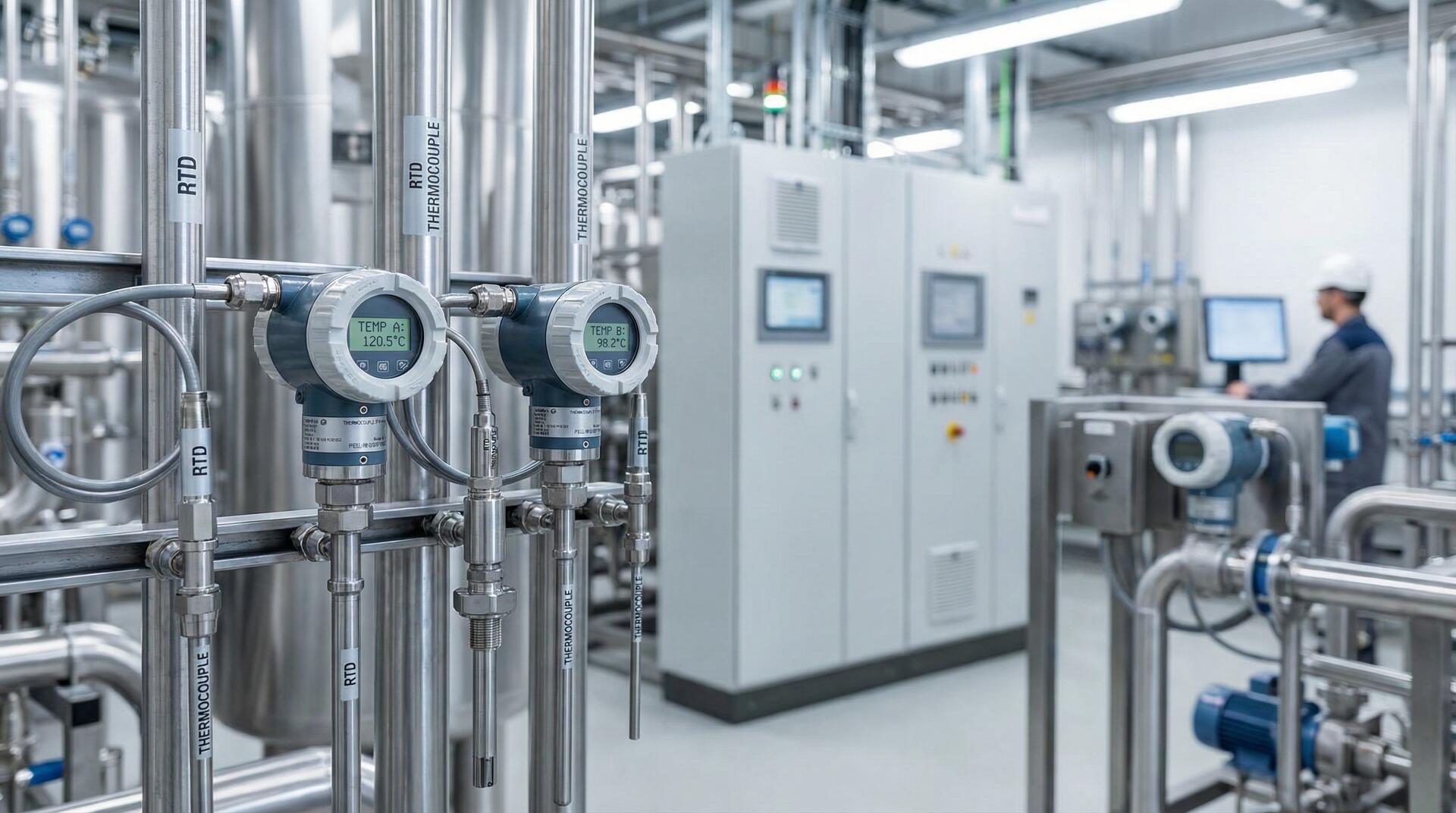
Temperature Measurement Solutions for Industrial Applications
Comprehensive guide to selecting and implementing temperature measurement solutions in industrial environments, covering thermocouples, RTDs, and infrared sensors.
Understanding Temperature Measurement Technologies
Temperature measurement is a critical aspect of industrial process control, quality assurance, and safety monitoring. Modern industrial facilities rely on accurate and reliable temperature sensors to optimize production efficiency, ensure product quality, and maintain safe operating conditions. This comprehensive guide explores the various temperature measurement technologies available today and helps you select the right solution for your specific application.
Types of Temperature Sensors
Thermocouples
Thermocouples are among the most widely used temperature sensors in industrial applications due to their wide temperature range, durability, and cost-effectiveness. They operate on the principle of the Seebeck effect, generating a voltage proportional to the temperature difference between two dissimilar metal junctions. Common thermocouple types include Type K (Chromel-Alumel), Type J (Iron-Constantan), Type T (Copper-Constantan), and Type E (Chromel-Constantan), each offering different temperature ranges and accuracy levels.
Type K thermocouples are the most popular choice for general-purpose applications, offering a temperature range from -200°C to +1350°C with good accuracy and stability. Type J thermocouples are suitable for reducing atmospheres and offer a narrower range of -40°C to +750°C. Type T thermocouples excel in low-temperature applications and oxidizing environments, while Type E thermocouples provide the highest output voltage among base metal thermocouples.
Resistance Temperature Detectors (RTDs)
RTDs offer superior accuracy and stability compared to thermocouples, making them ideal for precision temperature measurement applications. They operate on the principle that the electrical resistance of certain metals increases predictably with temperature. Platinum RTDs (Pt100 and Pt1000) are the most common type, offering excellent linearity, repeatability, and long-term stability.
RTDs are particularly well-suited for applications requiring high accuracy over a moderate temperature range (-200°C to +850°C). They are commonly used in pharmaceutical manufacturing, food processing, and laboratory environments where precise temperature control is essential. The main disadvantages of RTDs compared to thermocouples are their higher cost, slower response time, and more fragile construction.
Infrared Temperature Sensors
Non-contact infrared (IR) temperature sensors measure the thermal radiation emitted by an object to determine its temperature without physical contact. This makes them ideal for measuring moving objects, hazardous materials, or surfaces that are difficult to access. IR sensors are available in various configurations, including spot pyrometers, line scanners, and thermal imaging cameras.
Modern IR sensors offer fast response times, wide temperature ranges, and the ability to measure extremely high temperatures that would damage contact sensors. They are widely used in metal processing, glass manufacturing, semiconductor fabrication, and predictive maintenance applications. However, IR sensors require careful consideration of emissivity, atmospheric absorption, and background radiation to ensure accurate measurements.
Selection Criteria for Temperature Sensors
Temperature Range
The operating temperature range is the primary factor in sensor selection. Thermocouples offer the widest temperature range, making them suitable for high-temperature applications such as furnaces and kilns. RTDs provide better accuracy in moderate temperature ranges, while IR sensors can measure extremely high temperatures without contact.
Accuracy Requirements
Different applications have varying accuracy requirements. Laboratory and pharmaceutical applications typically require the high accuracy provided by RTDs (±0.1°C or better), while many industrial processes can operate effectively with the lower accuracy of thermocouples (±1-2°C). Consider both initial accuracy and long-term stability when selecting a sensor.
Response Time
Response time is critical in applications requiring rapid temperature changes or fast process control. Thermocouples generally offer faster response times than RTDs due to their smaller thermal mass. IR sensors provide the fastest response times, making them ideal for high-speed manufacturing processes.
Environmental Conditions
Consider the operating environment when selecting temperature sensors. Factors such as vibration, shock, humidity, corrosive atmospheres, and electromagnetic interference can significantly impact sensor performance and longevity. Thermocouples are generally more rugged than RTDs, while IR sensors are unaffected by harsh contact conditions.
Installation Best Practices
Proper Insertion Depth
For contact sensors, proper insertion depth is essential for accurate measurements. The sensor should be inserted deep enough to ensure the sensing element is fully immersed in the measured medium and not influenced by ambient conditions. As a general rule, the insertion depth should be at least 10 times the sensor diameter.
Thermal Wells and Protection Tubes
Thermal wells protect sensors from harsh process conditions, allowing sensor replacement without process shutdown. They should be properly sized to ensure adequate heat transfer while providing sufficient mechanical strength. Consider well material, wall thickness, and tip configuration based on process conditions and flow velocity.
Electrical Connections
Proper wiring and electrical connections are critical for accurate temperature measurement. Use the correct extension wire or compensating cable for thermocouples, and ensure proper shielding and grounding to minimize electrical noise. For RTDs, use three-wire or four-wire connections to compensate for lead resistance.
Calibration and Maintenance
Regular calibration ensures continued accuracy of temperature measurements. Establish a calibration schedule based on application criticality, regulatory requirements, and historical drift data. In-situ calibration using portable reference standards can minimize downtime, while laboratory calibration provides the highest accuracy.
Routine maintenance includes visual inspection for physical damage, verification of electrical connections, and periodic accuracy checks. Replace sensors showing signs of degradation, such as excessive drift, erratic readings, or physical damage. Maintain detailed calibration records to track sensor performance over time and identify trends that may indicate impending failure.
Emerging Technologies
Wireless temperature sensors are gaining popularity in industrial applications, offering easy installation and reduced wiring costs. These battery-powered sensors transmit data via wireless protocols such as WirelessHART, ISA100, or Bluetooth, enabling flexible sensor placement and simplified system expansion.
Smart temperature transmitters with digital communication protocols (HART, FOUNDATION Fieldbus, PROFIBUS) provide enhanced diagnostics, remote configuration, and improved accuracy through digital signal processing. These intelligent devices can detect sensor degradation, provide predictive maintenance alerts, and simplify troubleshooting.
Conclusion
Selecting the appropriate temperature measurement solution requires careful consideration of application requirements, environmental conditions, and performance specifications. Thermocouples offer wide temperature ranges and ruggedness, RTDs provide superior accuracy and stability, and IR sensors enable non-contact measurement of high temperatures. By understanding the strengths and limitations of each technology and following proper installation and maintenance practices, you can ensure reliable and accurate temperature measurement in your industrial processes.
Tags:
Related Articles
Analytical Instrumentation: A Comprehensive Selection Guide
Essential guide to selecting analytical instruments for process monitoring, quality control, and environmental compliance in industrial facilities.
Industrial Automation Best Practices: Optimizing Manufacturing Efficiency
Discover proven strategies and best practices for implementing industrial automation systems that improve efficiency, reduce costs, and enhance product quality.
Calibration and Maintenance Guide for Industrial Instrumentation
Essential guide to calibration procedures, maintenance schedules, and best practices for ensuring accuracy and reliability of industrial instruments.